

A Reader in Child Theology for those alongside Children in Church and Mission
Publisher: London: Child Theology Movement, 2026
Details: Paperback, 274pp
ISBN: 978-1068310423
Articles and Papers from 2004 to 2020
Since the 1960s there have been fresh perspectives on Christian theology focusing on, and typically involving active participation by, groups previously marginalised, whether in church or other institutions and discourses. These have been variously described as liberation or contextual theologies.
1979, the International Year of the Child, marked a recognition of the growing attention to children worldwide across a range of academic disciplines, professions and institutions, including theology and church. This paid increasing attention to their agency, rights and voices. Until then study or engagement with children had tended to be "pre-paradigmatic", often within an existing discipline or framework such as "family" or "education".
In 2001 following a conference in De Bron, Holland, a new concept, with an associated process and network, has been developing using the title Child Theology. One of the groups helping to nurture this is the Child Theology Movement.
Spurred by hundreds of theological questions from Christians alongside children it has become a global movement that has engaged and involved people from every continent, usually in consultations of clergy and lay people, practitioners and academics. Reports of many of these circles are accessible via the CTM website: www.childtheologymovement.org
This reader and its companion A Reader in Child Theology for Theologians presents a selection of papers from, and some writing prompted by, those events.
It is a serendipity that the twin volumes are being published in the year that CTM celebrates its 25th anniversary. The intention is that they might help to widen the network worldwide, and provide a resource and hopefully inspiration for further theological reflection, and practical action, with Jesus and children at its heart.
Reflections on the two Readers
Keith White, Chair of CTM, wrote this review of both Readers for their launch on 24th November 2026 at Mill Grove, London, in the 25th anniversary year of the Child Theology Movement.
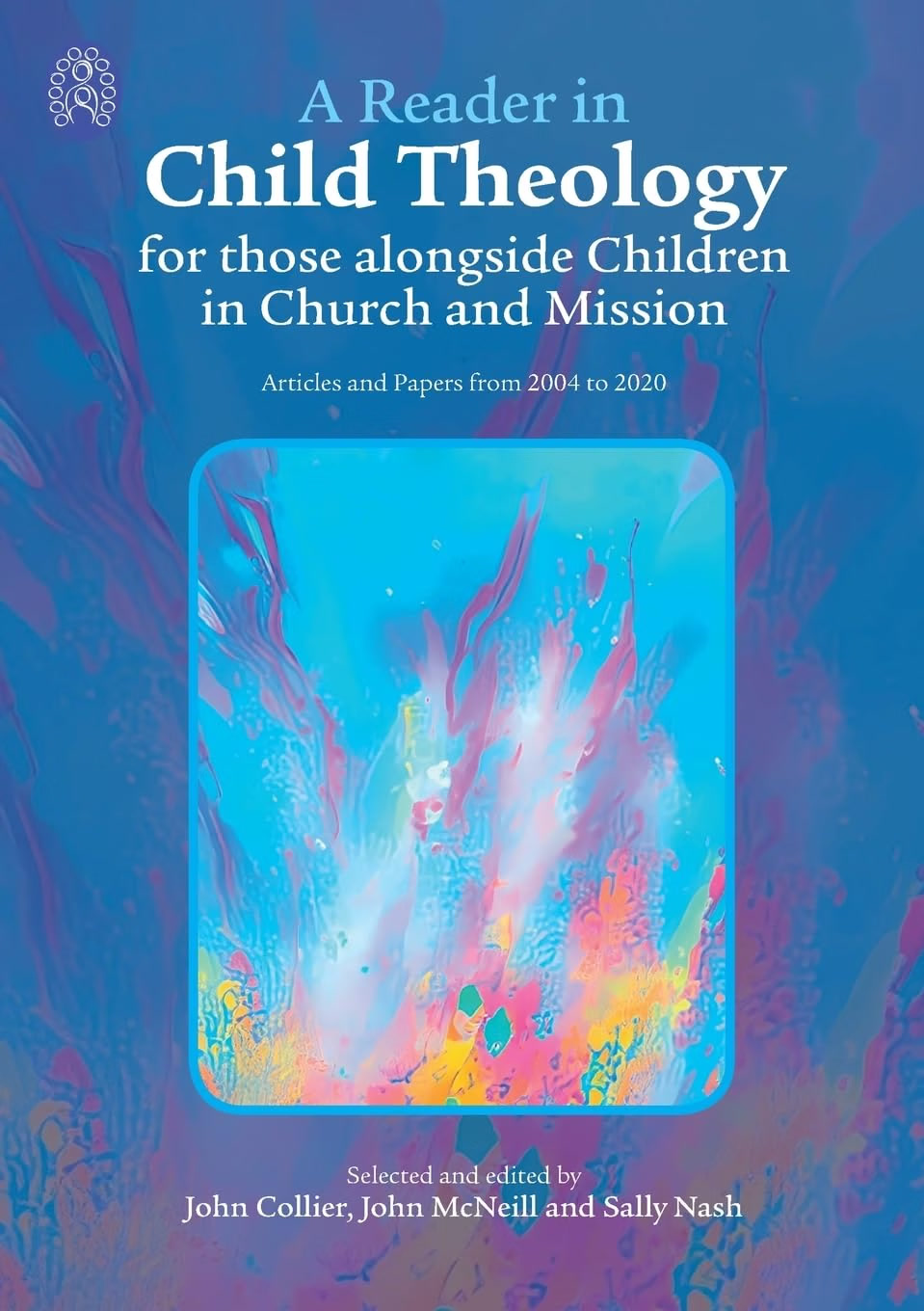
As the 25th anniversary of the emergence of the Child Theology Movement came into view, this twin publication seemed to be an appropriate way of celebrating the development of CTM from birth, childhood, youth and into adulthood. The covers make a modest attempt to suggest a birthday atmosphere. It was a team effort for which the following are to be thanked: John Collier for suggesting the idea; Sally Nash for selecting the material; John McNeill and Paul Butler, among others, for the editing; and Tony Cantale, the design and lay-out.
Revisiting the two sets of articles for the purposes of this review proved to be rather more of a surprise than I had expected. After all, I know most of the writers very well, and was often present when the papers were originally given.
There were two elements to this (very pleasant) surprise. First, put together in collections, the articles reflect how the whole process of CTM thus far represents an experiment requiring new ways of doing theology together. Second, they show just how pioneering and rich much of the exploration has been.
A Distinctive Process
The process provided the context for the study and writing of each piece. There are contributions from across the world, clerical and lay, men and women, professionals and volunteers, academics and practitioners. And there is no biographical information about any of them! This was partly due to the challenges of editing such diverse texts drawn from 25 years worldwide, but it is also because roles, institutions, and status have always taken a back seat in Child Theology.
Without formal courses or structures a community has been developing. As far as I am aware every contributor has acknowledged the insights of others, while in turn offering insights and lines of enquiry to others. Jerome Berryman, sadly no longer with us, provides an example of this. Many have been blessed by Godly Play. He was part of an early CT consultation in Houston in 2004. In 2012, he was a delegate at a conference convened by CT at Princeton Seminary and contributed to the book of that conference (The Logic of the Spirit in Human Thought and Experience). Marcia Bunge is another: The Child in Christian Thought, which she edited, was one of the early inspirations and resources for Child Theology. She contributed to several consultations and conferences and CTM played a role in the publication of the collection, The Child in the Bible.
A reader of either of the volumes launched on 25th November 2026 is invited to become part of this community, join its conversation, and perhaps, in some cases, to get to know old friends better.
When CTM met face to face around the world, we sat in circles whenever practicable. And this was a sign that as followers of Jesus, we were intentionally gathering around our Lord and Saviour as he called and welcomed a little child into our midst. We recounted and role-played this action of his in several different ways, because at the root of the whole endeavour was the belief that Jesus and the Kingdom of God were at the heart of things, signed by the little child.
The original CTM logo is on both collections, and this represents an attempt to portray this very point. There are no words or labels, so it could be a Madonna and Child, or Jesus and the Child. And the twelve gathered around could be disciples or others who were drawn to Jesus and the child. It is deliberately understated, seeking to be consistent with the humility which Jesus indicated as the key to entering God’s Kingdom.
After much discussion and careful thought, we concluded that it was not appropriate to invite children to write papers or articles, but they were sometimes present at our gatherings, and always in our minds. And we relished and thrived on their questions, typified by the little book, Children’s Letters to God.
A quarter of a century on, CTM itself continues to function in a non-hierarchical and non-partisan way. All the papers exemplify and contribute to this way of doing theology. The Introduction, which is common to both volumes, notes that the action of Jesus described in Matthew 18 interrupted a conversation and was designed to refocus the conversation about greatness in the Kingdom of God. It is precisely this action and teaching of Jesus that have interrupted our conversations as we have welcomed, usually in our imaginations or testimonies, a little child to be among us. There is no record that the little child said anything, but the two collections are testimony to the profound effect s/he has had on those of us who have sought to follow the lead of Jesus signed by the child.
Discoveries along the Way
So much for the process. What about the gleanings along the way? The content of the two volumes comprises a selection from a wealth of material: talks, lectures, articles, chapters and papers, produced since 2001. The pieces chosen are possibly best treated as samples. They are intended to encourage further exploration of the riches and depths of the child-attentive writing by followers of Jesus who have been inspired by a growing sense of wonder that they were mining a hitherto largely hidden or overlooked theological vein.
How far the division into collections for two distinct intended audiences will be received, and how they will be read, remains to be seen. But such an attempted classification serves as a reminder of one of the early aims of CTM quoted in the chapter “Child Theology and the Family” by Haddon Willmer:
“All theological reflection reformed with a child in the midst. All Christian child-related activity informed by theological reflection”.
(A Reader for Those Alongside Children (RFTAC), 64/5)
Running through both volumes, the reader will sense the creative tension that the authors are experiencing because Child Theology is a process that involves such a lively dynamic between “Child” and “Theology” (e.g. Sunny Tan Reader for Theologians (RFT), 29/30). One of the tangible contributions of CTM has been to chart some of the experiments and exploration of this relationship core to the whole venture. Haddon Willmer’s Triangle: Theology, Child, and Mission, is an example, that may well serve as an enduring model (RFT, 83-94). DJ Konz’s Child Theology and its Theological Method (RFT, 195-206) draws from the pioneering work of the book Entry Point (based on Matthew 18: 1-14), together with the discoveries his own PhD. He describes the latter as a “child-attentive” reading of the theology of Karl Barth.
There are varied possible starting points and methods. Yet, what becomes clear is that in holding both Child and Theology together (C+T as they are denoted in the Triangle, RFT, 83-94) in a variety of ways (comparison, dance, embrace etc.), Child Theology finds it is consistently drawn to Jesus, the Kingdom of God, and the individuality, diversity, humility and mystery of real children who the authors know. The presence of children in the writing and testimonies of the contributors is tangible: this is one of the primary and powerful ways in which children speak, without being given a platform or necessarily using words.
It should be noted that this is a characteristic of those engaged in CT as they have tried to be obedient to the example of Jesus when calling the little child. There is abundant evidence that real children have been welcomed in practical ways in the lives of the writers. Resulting from that welcome and the changes it engenders, there follows the attempt to explore and imagine the implications of this for church, theology and mission.
Kingdom of God and Contextual Theologies
Two distinctions running through the volumes are between the Kingdom of God and Church; and Child Theology and Contextual Theologies such as Liberation, Black, Feminist and Womanist Theology (e.g. Carlos Quieroz, RFT, 55-63). Child Theology emerges as always tending beyond the realm of ecclesiology to God’s mission in the whole of creation and history. In doing so, it is not in competition with movements dedicated to seeking with good cause to draw attention to and increase the agency of specific types of groups of people. (See also “Child Theology and Liberation Theologies”, RFTAC, 137-166; and Frances Young, “A Theological Response to Child Theology”, RFTAC, 233-245 and RFT, 178-194).
Child Theology is a witness to the whole of humanity (DJ Konz, RFT, 244-261). A memorable quotation is: “to people, not only of all nations, but of all ages” (261).
The Call of Jesus
The material all through is characterised by enquiring, informed, aware and committed attention to the Scriptures, in a way that contrasts with that of some contextual theologies. This is, of course, a challenging process, but the rewards are evident everywhere, with insights that may come to some readers as little short of revelations. Among these are the exposition of the whole biblical theme of “call” or vocation.
The article of Elizabeth Barnett (RFT, 115-131) focuses on the phrase, “Jesus called a little child”. It throws new light on the unfolding narrative of Matthew’s Gospel. Having called the twelve disciples to follow him, Jesus has reached a critical stage in his mission: those he has called have cottoned on to the truth that the Kingdom of God is at the heart of the life and teaching of their Lord. But they have completely missed the point that this Kingdom is upside-down, inside-out and back to front when compared to the kingdoms of human history.
It is at this very moment that Jesus does something unparallelled in his ministry: He calls a little child into their midst. (The call of Jesus distinguishes this incident from those where others are bringing children to Jesus for him to bless them, Matthew 19: 3, Mark 10: 13-16). Whatever the disciples made of the action of Jesus, the reader is under no illusions: this is the call of another person to come not just close to Jesus and his disciples, but one whom Jesus then places in their very midst. He spells out the significance of this action in ways which still surprise New Testament theologians. Putting the accounts of the Synoptic Gospels together, we find that in welcoming this called child, the disciples will be welcoming Jesus and the One who sent him.
Beth invites us to allow this single action to resonate with the significance of God’s calling throughout the Scriptures. One example of this is a puzzling verse in Psalm 2. Both volumes include an article based on Psalm 8 (RFTAC, 9-18; RFT, 95-104), which focuses on the verse that Jesus quoted later in his journey towards the cross in Matthew’s telling of the story. When young people were being criticised for praising God loudly in the temple, Jesus referred to Psalm 8 verse 2, to explain that it was their God-given calling to praise as a way of entering the conflict between the Creator and the “foe and the avenger”.
The Humility of Jesus and the Child
Another rich vein is that of humility. As with call and calling, the writers take their clue from Jesus when he applied the word, humble, to a requirement for entering the kingdom of God. Jesus singles out humility in Matthew 18, whatever it may mean in this context. (Entry Point interprets it as relating to the lowly status of children rather than any, innate or acquired, personal quality or virtue.) It was the one descriptor of a child or childhood that he gave his disciples in Matthew 18. It is also part of Matthew’s telling of the entry of Jesus into Jerusalem (ch. 21, quoting Zechariah 9: 9). Because of his conscious identification of the little child with himself, Paul’s description of Jesus becoming humble (Philippians 2), echoes through the volumes (for example, Frances Young, RFT, 178-194; and RFT, page 234).
Like the challenge Jesus gave to the misguided understandings of his disciples about the nature of the Kingdom of God, the deliberations of CTM have retained a critical edge, sometimes challenging long cherished and deeply imbedded practice, assumptions and beliefs, secular and Christian. Among those in these volumes are the respective roles of God’s Spirit and human effort and design in mission and the prevailing views of human development seen as predictable stages and steps, whether emotional or spiritual (RFT, 161-177; RFTAC,167-190); existing theological formulations of anthropology (RFT 143-160; RFTAC, 250-267), sin (RFT, 31-54), ecclesiology conceived without serious attention to the little child called and placed by Jesus in our midst (RFTAC, 116-121; RFT, 9-30).
The volumes indicate a readiness to seek to draw from, and apply to, every part of the Scriptures, and likewise every aspect of human life and existence. This is testimony to the unique universality of child. Given that Jesus chose a little child to make a pivotal point about the key to entry to the Kingdom of God, it is puzzling that so much effort in theology and mainstream church and mission has been expended without reference to this singular, yet widely significant action and teaching.
Seedtime and Harvest
Twenty-five years in the life of the church of Jesus Christ is a very short time, but it has already yielded some rich crops. Perhaps, in years to come, these two volumes will be identified as some of the “First-fruits”. But equally, they may be seen as more seeds whose harvest is yet to come.
Keith White, Chair of CTM